Software License Entitlements and Monetization - Market Analysis Report 2026
The global software license management market has evolved into a sophisticated ecosystem where traditional perpetual licensing gives way to dynamic, consumption-driven models. Valued at USD 3.67 billion in 2026, the market is projected to reach USD 18.1 billion by 2037, representing a compound annual growth rate (CAGR) of 13.7%1. This expansion is fundamentally reshaping how software vendors monetize products and how enterprises manage their digital assets.
The transformation is driven by three converging forces: the acceleration of cloud computing and SaaS adoption, the emergence of AI-powered automation in licensing and compliance, and the market-wide shift toward usage-based pricing models that align customer costs with actual value consumption. Organizations now demand real-time visibility into software spend rather than periodic reports, creating urgency for intelligent, cloud-native license management platforms.
For software vendors and enterprise customers alike, 2026 represents a pivotal inflection point. Vendors must transition from license-and-maintenance models (now used by only 24% of providers) to flexible hybrid and consumption-based approaches. Enterprises require sophisticated entitlement management that spans on-premises, cloud, and hybrid environments while automating compliance verification. The vendor that effectively bridges these requirements—combining real-time intelligence, AI-driven optimization, and seamless cloud integration—will capture disproportionate market share in this high-growth sector.
1. Market Overview and Valuation
1.1 Current Market Size and Growth Trajectory
The software license management market continues its accelerated expansion trajectory. In 2026, the market is valued at approximately USD 3.67 billion, a 7.8% increase from the 2024 baseline of USD 3.41 billion1. Multiple research methodologies confirm this growth pattern, with projections consistently pointing to a market valued between USD 9.1 billion and USD 18.1 billion by 2032–2037, depending on the forecast scope.
This robust growth reflects a fundamental recognition across enterprises that software licensing is no longer a back-office compliance function. Instead, it has become a strategic operational lever for cost optimization, revenue acceleration, and risk mitigation. The heterogeneity of projections underscores the breadth of the opportunity: the entitlements market encompasses traditional enterprise license management, emerging SaaS monetization platforms, cloud-native licensing infrastructure, and AI-powered compliance automation systems.
1.2 Regional Market Dynamics
North America maintains its position as the dominant regional market, commanding over 35% of global market share by 2035, driven by the concentration of major software vendors, stringent compliance regulations, and the complexity introduced by distributed remote workforces. Europe represents the second-largest market opportunity, with accelerated growth propelled by GDPR compliance requirements and heightened cybersecurity mandates that necessitate sophisticated license tracking and audit capabilities.
The Asia-Pacific region, while currently smaller in absolute market size, exhibits the highest growth velocity. Rapid digital transformation initiatives in emerging economies and the proliferation of cloud adoption create fertile ground for license management solutions that can scale elastically across distributed operations.
2. Definitional Framework and Market Segmentation
2.1 Software License Entitlements: Core Concept
Software license entitlements represent the contractually specified rights granted to end-users or organizations to utilize a software product under defined parameters. These parameters encompass the scope of permitted users, accessible features, duration of use, deployment geography, and specific usage restrictions. The entitlement management function ensures that software usage aligns with contractual terms, protecting vendor intellectual property while maintaining customer compliance and minimizing legal exposure for both parties.
In 2026, the sophistication of entitlement definitions has expanded considerably. Traditional binary grant structures (licensed or unlicensed) have been supplanted by granular, multi-dimensional entitlement models that reflect the complexity of modern software delivery. A single customer may hold multiple overlapping entitlements—perpetual licenses for certain modules, monthly subscriptions for cloud services, usage-based access for API endpoints, and floating license allocations for shared resources—all requiring unified management.
2.2 Software Monetization in the Modern Context
Software monetization encompasses the portfolio of pricing and revenue models through which vendors extract economic value from their intellectual property. The 2026 monetization landscape reflects a fundamental industry realignment: subscription and usage-based models now account for 76% of software vendor offerings, while license-and-maintenance models have declined to 24% of deployed solutions2.
The monetization transition reflects a deeper economic shift. Usage-based models align vendor revenue with customer value realization, creating natural incentive alignment and reducing customer acquisition friction. When customers pay proportionally to the benefit they derive from a product, price sensitivity decreases and customer lifetime value typically increases. For vendors, usage-based pricing enables predictable recurring revenue streams while capturing upside from customers who experience rapid value multiplication.
2.3 Relationship to Software Asset Management
Software Asset Management (SAM) remains the broader organizational discipline encompassing the management, control, and protection of all software assets within an organization. Licensing represents a critical component of SAM, but SAM extends to hardware-software relationships, compliance risk assessment, vendor contract management, and strategic IT portfolio optimization.
This report focuses on the vendor perspective—specifically, how software companies create, manage, and monetize entitlements to drive revenue and customer value. While SAM addresses the enterprise customer’s need to optimize existing software investments, our analysis examines the strategic approaches vendors employ to design licensing mechanisms that maximize lifetime customer value while reducing support friction and compliance risk.
3. Market Drivers and Growth Catalysts
3.1 Cloud Computing and SaaS Acceleration
The migration from on-premises software toward cloud-based SaaS delivery represents the single largest driver of license management market growth. Cloud environments introduce fundamental differences in software economics: users access applications over the internet rather than deploying locally, consumption fluctuates dynamically, and pricing mechanisms must accommodate variable usage patterns.
Traditional perpetual licensing—appropriate for stable, on-premises deployments—proves economically inefficient in cloud environments. Instead, cloud-native businesses have adopted subscription-based access (paying recurring fees for continuous availability) and consumption-based pricing (paying according to actual usage metrics). This shift necessitates entirely new technical infrastructure for real-time usage tracking, automated billing, compliance verification, and customer self-service. Vendors must invest in cloud-native license management platforms that integrate seamlessly with cloud infrastructure (AWS, Azure, Google Cloud) rather than legacy on-premises licensing systems.
3.2 Portfolio Complexity and Optimization Imperative
Enterprise software portfolios have grown exponentially in size and heterogeneity. The average organization now manages licensing for dozens or hundreds of distinct software applications, each with unique terms, pricing structures, renewal dates, and usage constraints. This complexity creates two compounding problems: (1) hidden costs from unused licenses, over-purchased concurrent licenses, and inadvertent non-compliance, and (2) operational friction from manual tracking and renewal management.
Organizations increasingly recognize software spend as a controllable budget line. Finance teams, facing margin pressure, view software optimization as a discretionary lever. A recent industry survey found that 41% of enterprise software spend is wasted through unused or underutilized licenses—representing billions in potential cost recovery. Sophisticated license management platforms that provide visibility into utilization patterns, automate renewal optimization, and recommend rightsizing enable enterprises to recover 8–12% of annual software spend. This ROI dynamic drives adoption independent of regulatory requirements.
3.3 Compliance Risk and Regulatory Mandates
Audits by software vendors and regulatory authorities impose substantial financial and operational costs on non-compliant organizations. A single audit finding can result in six-figure remediation penalties. More concerning, enterprise customers now face environmental, social, and governance (ESG) scrutiny from investors regarding their supply chain compliance posture, including whether they maintain proper software licensing agreements with vendors.
In Europe, GDPR and related data protection regulations have established compliance as a non-negotiable requirement. In North America, regulatory frameworks governing specific industries (financial services, healthcare, defense) mandate comprehensive software asset inventories. These regulatory drivers create sustained demand for enterprise-grade license management systems that can audit usage, generate compliance reports, and prove adherence to licensing agreements.
3.4 Emerging IoT and Edge Computing Ecosystems
The proliferation of connected devices and edge computing introduces new monetization opportunities for software vendors. Traditional user-based licensing metrics (cost per seat) prove inadequate for IoT deployments with thousands or millions of connected devices. Instead, vendors are developing device-based, API-call-based, and data-volume-based licensing mechanisms that scale to accommodate massive device populations.
This creates demand for licensing infrastructure specifically architected for high-volume, low-cost-per-unit monetization models. Vendors require systems capable of processing millions of concurrent license checks, handling real-time usage metering across distributed device networks, and supporting granular pricing differentiation based on device capabilities or regional deployment.
4. Key Market Trends Shaping Software Licensing in 2026
4.1 Consumption-Based Pricing: From Exception to Standard
The acceleration of usage-based and consumption-based licensing represents the most significant structural shift in the industry. In these models, customer charges correlate directly to actual utilization—measured by transactions processed, data volumes analyzed, API calls consumed, compute hours consumed, or feature-specific usage metrics.
The adoption trajectory has proven steeper than anticipated. In 2023, approximately 40% of software companies had experimented with usage-based pricing. By 2026, this percentage has risen substantially, with early adopters reporting significantly higher customer lifetime value, reduced churn, and improved pricing perception among customers. The reasons are economically compelling:
For vendors: Usage-based pricing enables automatic price elasticity. As customers derive more value and expand their usage, revenue grows proportionally without requiring contract renegotiation. This creates powerful incentive alignment and reduces friction associated with annual renewal discussions. Customers perceive fairness in consumption-based models because they pay precisely for what they consume.
For customers: Organizations can scale software usage according to business needs without requesting licensing expansion or incurring large upfront capital commitments. The financial model becomes more predictable and flexible, enabling rapid expansion during growth periods and graceful cost reduction during downturns.
However, consumption-based pricing introduces operational complexity. Vendors require sophisticated usage metering, real-time billing infrastructure, and transparent customer portals for consumption visibility. Implementation challenges have slowed broader adoption, but 2026 marks the inflection point where the percentage of companies implementing usage-based models has exceeded those using traditional perpetual or subscription-only approaches.
4.2 Real-Time License Intelligence and Operational Analytics
Organizations have transitioned from quarterly or annual compliance reporting toward continuous, real-time license intelligence. This shift reflects operational necessity: in cloud and SaaS environments, software consumption fluctuates daily or hourly, rendering periodic snapshots obsolete.
Real-time license intelligence platforms provide continuous monitoring of software utilization, compliance posture, and financial exposure across heterogeneous environments. Rather than generating annual compliance reports, modern solutions offer operational dashboards that track:
- Utilization metrics: Per-user consumption patterns, feature adoption, peak usage periods
- Compliance status: License agreement adherence, expiration forecasting, audit-readiness metrics
- Financial exposure: Projected annual spend, cost per user trends, renewal optimization opportunities
- Procurement optimization: Recommendations for consolidation, rightsizing, or alternative licensing models
Finance and IT operations teams now expect real-time integration of license data into their standard operational dashboards. This enables data-driven decision-making and rapid response to utilization anomalies. The shift from periodic reporting to continuous intelligence has become a baseline competitive requirement rather than a differentiation point.
4.3 Artificial Intelligence in Pricing Optimization and Compliance Automation
Artificial intelligence and machine learning are increasingly embedded within license management platforms to accomplish two critical functions: pricing optimization and automated compliance verification.
Pricing optimization: AI systems analyze historical usage patterns, customer churn data, feature adoption metrics, and competitive pricing intelligence to recommend optimal price points for customer segments. These systems identify opportunities to adjust pricing architecture—for example, introducing new metric dimensions, adjusting price levels, or creating new tier configurations—with minimal customer friction. Early adopters report 5–15% revenue uplift from AI-driven pricing optimization without corresponding increases in customer acquisition cost.
Compliance automation: AI systems can automatically map software usage to license agreements, identify potential violations, and recommend remediation actions. Rather than requiring manual audit labor, AI systems continuously monitor for compliance drift and flag issues in real-time, enabling faster resolution and reduced financial exposure. Compliance-automating AI can integrate with vendor audit systems, providing transparent documentation of adherence without requiring extensive manual compilation.
The emerging category of “compliance-automating AI” extends beyond software licensing to encompass regulatory compliance broadly. These systems can analyze regulatory requirements, translate them into operational procedures, monitor adherence automatically, and generate required transparency reports. This functionality, while still emerging, will become standard in enterprise license management by 2027–2028.
4.4 Hybrid Licensing Models and Flexibility
No single licensing model dominates every customer segment or use case. Instead, enterprise vendors increasingly offer hybrid models that combine multiple monetization approaches within a unified contract structure:
Base subscription + usage overage: Customers pay a fixed monthly or annual subscription for guaranteed access plus additional charges for consumption beyond predefined thresholds. This model balances predictability (via the subscription base) with fairness (via consumption alignment for heavy users).
Tiered subscription with usage options: Customers select a service tier based on team size or feature access, then can pay incrementally for additional consumption. This approach accommodates both stable baseline usage and variable peak demand.
Credit-based pricing: Customers pre-purchase usage credits (redeemable for specific actions) and consume them as needed. This model simplifies billing while providing flexibility and encouraging customer investment in the product.
Outcome-based licensing: Emerging in professional services and enterprise software, some vendors are experimenting with pricing tied to customer business outcomes—for example, cost savings achieved or revenue generated. This represents the frontier of pricing alignment but remains limited to high-value, custom implementations.
The proliferation of hybrid models reflects market maturity. Vendors recognize that customer segments exhibit heterogeneous usage patterns and preferences. Rather than imposing a single model, successful vendors offer flexibility to accommodate diverse customer needs while maintaining operational simplicity in billing and compliance.
4.5 Cloud-Native Architecture and Decentralized Deployment
License management platforms are increasingly architected as cloud-native solutions rather than on-premises applications. This shift enables several advantages: automatic scalability to accommodate enterprise deployments with millions of users, elimination of customer infrastructure investment requirements, seamless integration with cloud resource monitoring, and rapid feature deployment via continuous deployment pipelines.
Cloud-native license management systems provide vendors with natural observability into deployment and usage patterns, enabling rapid identification of emerging use cases, feature adoption trends, and potential optimization opportunities. The architecture also enables transparent, automated customer self-service—for example, users can request license provisioning directly through cloud dashboards rather than submitting support tickets.
Decentralized deployment architectures (edge computing, containerized microservices) introduce additional complexity. License validation must occur at the edge with minimal latency to avoid customer application slowdowns. This requires sophisticated caching, offline-first design, and eventual consistency models rather than centralized validation. Organizations that successfully implement these patterns create differentiation through superior customer experience.
4.6 Integration with Enterprise Software Asset Management Platforms
The relationship between license management solutions and broader Software Asset Management (SAM) platforms has deepened. Progressive organizations are integrating license entitlement data with hardware inventory, software usage data, and compliance requirement tracking within unified platforms. This integration enables more sophisticated optimization—for example, matching cloud license instances to underlying resource allocations to identify consolidation opportunities.
Integration extends to IT Service Management (ITSM) platforms, enabling licensing considerations to influence infrastructure decisions and vice versa. For example, licensing data can inform virtual machine allocation decisions, or infrastructure changes can trigger automatic license recalculation and compliance verification.
5. Competitive Landscape and Market Segmentation
5.1 Market Composition and Participant Categories
The software license management market comprises several distinct participant categories, each serving different customer segments and use cases:
Enterprise-grade platforms serve large organizations with complex, heterogeneous software portfolios. These platforms emphasize deep integration capabilities, sophisticated compliance reporting, and multi-dimensional usage analytics. Vendors in this category compete primarily on feature breadth, integration depth, and customer support sophistication rather than price.
Cloud-native SaaS platforms focus on usage-based billing infrastructure and consumption-driven monetization. These platforms emphasize API-first architecture, high-volume metering capabilities, and real-time customer transparency. The customer base consists primarily of software-as-a-service vendors seeking to monetize their cloud offerings.
Open-source solutions address organizations with strong engineering capabilities and limited budgets. These solutions provide foundational licensing infrastructure but typically require substantial customization and integration effort. The open-source community maintains several mature licensing management projects, though the most sophisticated capabilities remain in proprietary products.
Embedded licensing solutions target independent software vendors building licensing directly into their applications. These solutions provide software development kits and runtime libraries enabling developers to implement licensing functionality without building from scratch.
5.2 Regional Competitive Dynamics
North American vendors dominate the enterprise license management segment, reflecting the regional concentration of large software vendors and mature enterprise IT spending patterns. European vendors have gained prominence in compliance-focused solutions, benefiting from GDPR expertise and the region’s stringent data protection requirements. Asian vendors increasingly compete in cost-sensitive markets and IoT-specific licensing applications.
The geographic distribution of the market is gradually shifting toward Asia-Pacific as digital transformation accelerates in emerging economies and cloud adoption becomes ubiquitous. Vendors with strong presence in Asia-Pacific are well-positioned to capture growth in this high-velocity region.
6. Customer Perspectives and Adoption Drivers
6.1 End-User Segment Analysis
Financial services and banking (BFSI) represents the largest end-user segment, maintaining projected dominance through 2035. The driver: accelerating digitization requirements and the regulatory mandate for comprehensive software asset tracking. Financial institutions are simultaneously reducing infrastructure footprints and increasing digital service offerings, creating dual pressures to optimize software spending and maintain comprehensive compliance documentation.
Enterprise software and technology companies constitute the second-largest segment, driven by the need to manage increasingly complex software portfolios and growing usage-based licensing adoption. These organizations recognize license management as essential to support modern cloud-native business models.
Manufacturing and industrial sectors are emerging as high-growth segments, driven by Industry 4.0 digitization initiatives and the proliferation of embedded software in manufacturing equipment and processes.
6.2 Customer Purchasing Criteria
Enterprise customers evaluating license management solutions emphasize several key criteria:
Visibility and reporting: Comprehensive visibility into software usage, licensing terms, compliance status, and financial exposure across on-premises and cloud environments.
Automation: Automated usage metering, compliance verification, and renewal optimization that minimize manual administrative effort.
Integration: Seamless integration with existing enterprise systems—ITSM platforms, financial systems, cloud infrastructure providers—to minimize implementation effort and maintain data coherence.
Scalability: Ability to scale from hundreds of users to millions of devices and API calls without corresponding increases in operational overhead.
Flexibility: Support for diverse licensing models (perpetual, subscription, usage-based, hybrid) and ability to accommodate custom licensing arrangements.
Organizations demonstrate clear purchasing preference for unified platforms that consolidate multiple licensing functions rather than point solutions requiring integration. This preference drives consolidation in the market, benefiting large, well-capitalized vendors capable of offering comprehensive solutions.
7. Market Opportunities and Growth Trajectories
7.1 High-Growth Opportunity Areas
AI-powered optimization: Demand for AI-driven pricing optimization, usage prediction, and compliance automation continues to accelerate. Vendors investing in AI capabilities are capturing premium valuations and customer willingness to pay. This remains the highest-growth segment within the broader market.
Cloud-native monetization platforms: As SaaS adoption accelerates and companies experiment with consumption-based pricing, demand for specialized cloud monetization platforms (billing infrastructure, usage metering, pricing engines) exceeds supply. Specialized vendors in this space command high customer valuations.
Regulatory compliance automation: The intersection of emerging regulations (AI governance, ESG compliance, data privacy) with software licensing creates demand for specialized compliance solutions. Organizations face complexity in mapping software usage to regulatory requirements and demonstrating ongoing adherence.
Edge and IoT licensing: Device-based and edge computing licensing remains nascent but rapidly expanding. Vendors providing sophisticated licensing infrastructure for IoT environments are establishing early market positions in an anticipated high-growth segment.
7.2 Market Expansion Dynamics
The market will continue expanding through three mechanisms:
Deepening penetration in existing enterprise segments as organizations recognize the financial and operational value of sophisticated license management.
Horizontal expansion into SMB and mid-market segments as cloud-native solutions reduce implementation friction and lower total cost of ownership.
Vertical specialization in industry-specific licensing requirements (healthcare, financial services, manufacturing, government) as vendors develop domain expertise and tailored solutions.
8. Challenges and Market Barriers
8.1 Operational Complexity
The diverse landscape of licensing models, pricing structures, and deployment architectures creates substantial operational complexity. Organizations often lack internal expertise to manage sophisticated licensing and monetization strategies, requiring external consulting and implementation support. This complexity slows adoption and increases customer acquisition costs for vendors.
8.2 Legacy System Integration
Existing license management systems in large enterprises often consist of heterogeneous point solutions, custom developments, and legacy platforms accumulating technical debt. Migrating from these legacy systems to modern platforms requires substantial effort, creating organizational resistance and implementation risk. Vendors that successfully address legacy integration win significant market opportunities, while those requiring complete rip-and-replace implementations face adoption barriers.
8.3 Piracy and Compliance Risk
Unauthorized software use and licensing non-compliance create ongoing challenges for vendors. While technology solutions can reduce piracy risk, social engineering and determined adversaries continue finding circumvention methods. Vendors must balance strong compliance mechanisms with reasonable customer friction—excessive enforcement mechanisms alienate legitimate customers.
8.4 Regulatory Uncertainty
Emerging regulations around AI, data privacy, and software licensing create uncertainty about required compliance mechanisms. Vendors must navigate divergent regulatory requirements across geographies while remaining flexible to accommodate changing requirements. Organizations often defer licensing platform migrations until regulatory requirements stabilize, creating procurement hesitation.
9. Strategic Recommendations for Vendors
9.1 Embrace Hybrid Monetization Architecture
Successful vendors recognize that customer needs are heterogeneous and licensing models will continue diversifying. Building flexible platforms that accommodate perpetual, subscription, usage-based, and hybrid models—rather than standardizing on a single approach—positions vendors to serve broader customer bases and adapt to evolving market preferences.
9.2 Prioritize Cloud-Native Design and API-First Architecture
The market is decisively moving toward cloud-native architectures. Vendors with on-premises-centric designs face growing competitive pressure. Prioritizing cloud-native infrastructure, API-first development, and seamless cloud integrations ensures long-term competitiveness and enables rapid feature deployment and customer integration.
9.3 Invest in AI and Predictive Analytics
AI represents the highest-growth segment within licensing and monetization. Vendors that develop sophisticated AI capabilities for pricing optimization, usage prediction, and compliance automation capture customer willingness to pay premiums and gain differentiation. This remains a frontier opportunity with limited competitive saturation.
9.4 Build Comprehensive Integration Ecosystems
Success increasingly depends on integration with surrounding enterprise systems—ITSM platforms, cloud providers, financial systems, HR systems. Vendors that develop rich, documented, and well-maintained integrations with major enterprise platforms significantly reduce customer switching costs and increase customer lifetime value.
9.5 Develop Industry-Specific Solutions
Vertical specialization presents substantial growth opportunity. Developing licensing solutions tailored to specific industry requirements (healthcare compliance, financial services regulations, manufacturing asset tracking) enables vendors to command premium pricing and establish durable competitive moats in specific segments.
10. Conclusion
The software license entitlements and monetization market stands at an inflection point. Traditional perpetual licensing continues declining while consumption-driven, cloud-native models accelerate. The market will expand from USD 3.67 billion in 2026 to USD 18.1 billion by 2037, representing an attractive investment opportunity for vendors and a critical operational lever for enterprises.
Success in this market requires vendors and customers to embrace flexibility, invest in intelligent automation, and recognize that licensing is no longer a peripheral compliance function but a strategic business capability. Organizations that execute this transition effectively will capture disproportionate value. Those that resist face competitive and financial pressure as market leaders establish dominant positions and establish network effects that reinforce their market leadership.
The next two to three years will determine the competitive composition of the market. Vendors that invest in AI-powered capabilities, cloud-native architecture, and comprehensive ecosystem integration will establish leadership positions. Those that continue optimizing legacy on-premises platforms risk irrelevance as the market decisively shifts toward modern architectures and intelligent monetization approaches.
- “Software License Management Market Size & Share, Growth Trends 2037”, Sep 11, 2025, https://www.researchnester.com/reports/software-license-management-market/5204
- “Top 10 Compliance Automation Tools in 2025”, June 25, 2025, https://www.cloudnuro.ai/blog/top-10-compliance-automation-tools-in-2025
Image Credits: NetLicensing
Related Posts

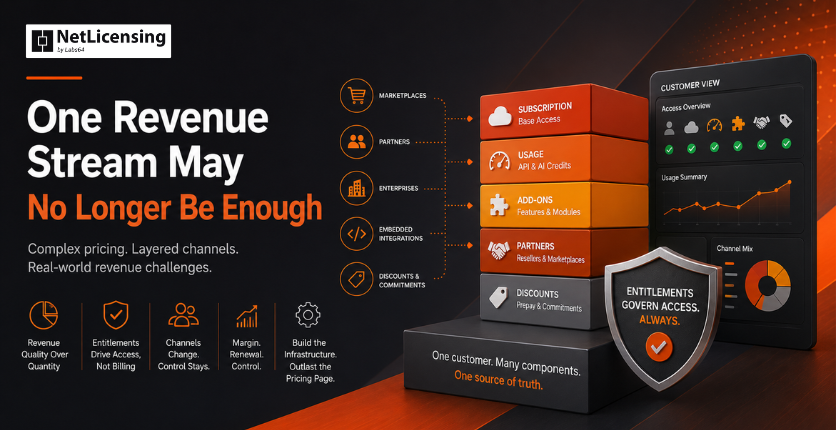
One Revenue Stream May No Longer Be Enough