One Revenue Stream May No Longer Be Enough
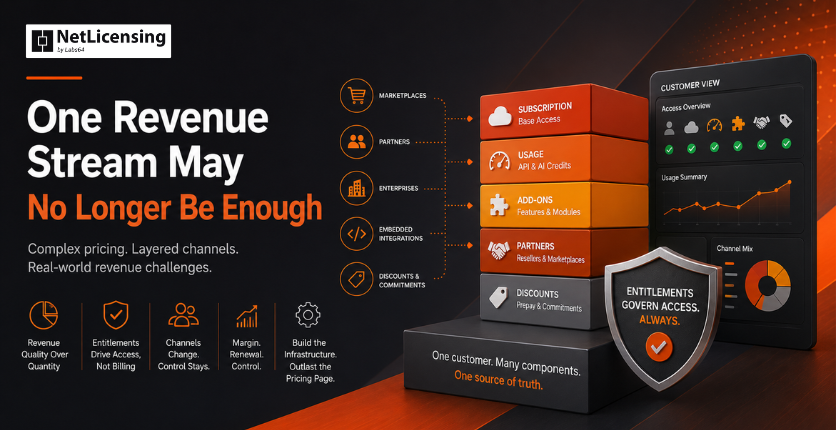
Selling software used to be more straightforward. You had a product, you set a price, and someone paid it - a perpetual license, a yearly subscription, a one-off invoice. Both sides knew what the deal was.
That’s harder to say now.
A single customer relationship today can involve a base subscription, usage credits for API calls, feature add-ons, reseller margins, AI consumption billing, and an annual prepayment discount - all at once. Each piece made sense when someone proposed it. Together they create a system that’s genuinely difficult to reason about, let alone operate.
Layered pricing isn’t inherently wrong. It can align cost more closely with value and reach customer segments that a flat subscription excludes. But every layer you add raises structural questions you’ll have to answer eventually.
Who controls what the customer can access? What happens when they exceed a quota, or cancel one component but keep another, or when a reseller contract ends while the end customer is still active? Not edge cases - normal operational situations that get harder as the pricing model gets more complex.
Not all revenue is the same quality
The impulse to add revenue streams is understandable. A new pricing idea looks attractive on paper, so you add it. But volume of revenue streams is the wrong thing to optimize for.
Partner-driven sales can look great on a revenue report and uncomfortable on a margin report. Usage-based billing introduces volatility you didn’t plan for. Advertising components can damage the product experience for customers who previously had something clean. Wholesale distribution can widen your reach while quietly eroding the direct customer relationship you built over years.
Revenue quality - margin, renewal likelihood, operational cost, how much control you retain - matters more than revenue volume. Most teams only really believe this after something breaks.
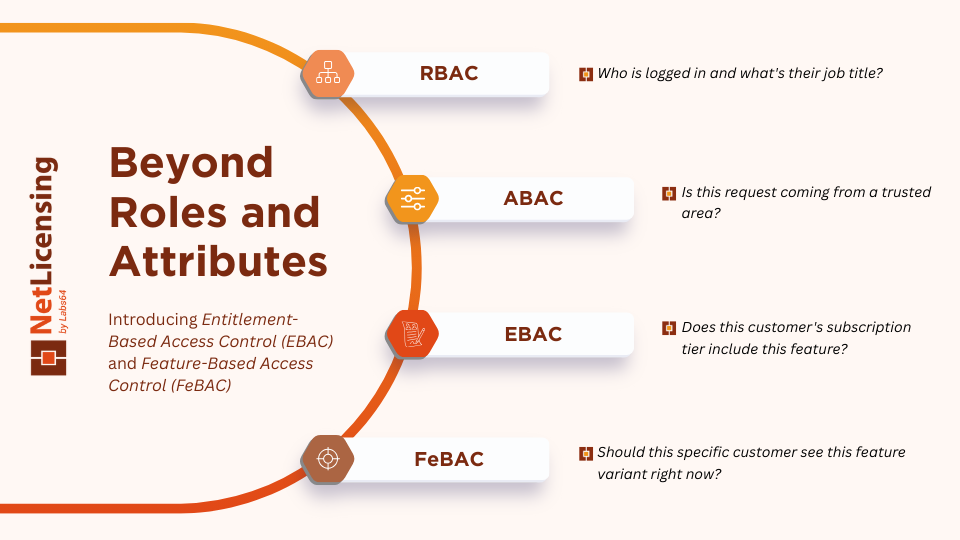
There’s also a distinction that gets glossed over: billing and licensing are not the same thing. Billing records what someone should be charged. Licensing and entitlement management determine what they’re actually allowed to do, under what conditions, and for how long. With simple pricing, the gap between these is small enough to ignore. With layered pricing, it isn’t.
A customer with an active annual contract might still have no access to a specific AI feature because their usage credits ran out. Another might get a particular module through a reseller bundle that direct customers pay extra for. A trial user has different feature access than a paid user, and an enterprise customer might have offline rights that neither of them has. If all of this lives in product code, billing plans, and spreadsheet notes, you will eventually encounter combinations you didn’t anticipate.
How it usually goes wrong
Monetization complexity rarely arrives all at once. Someone adds a usage tier. Someone else negotiates a custom enterprise deal. A partner program launches. AI features go live with their own credit model. Annual prepayment gets a quota attached. Each change was reasonable in isolation. None of them was designed to integrate with the others.
The result is the same pattern across most software businesses that have been through it: entitlement logic scattered across product code, billing plans, CRM fields, support tickets, and spreadsheets. Customers get charged for things they shouldn’t. Valid users get locked out because plan data is stale. Partner reporting becomes unreliable. Pricing experiments require engineering work.
The cleaner approach is to separate what the commercial agreement says from what the product enforces. The application doesn’t need to understand every pricing rule. It needs to ask one question - does this customer have access to this feature, quota, or usage type? - and get a reliable answer back, regardless of how the underlying deal is structured.
This is where a licensing service like NetLicensing fits into the picture. Not primarily as a place to store license keys, but as the layer that manages entitlements, validates usage, and keeps that logic out of application code where it becomes expensive to change.
Who owns the customer relationship?
As distribution gets more layered - more partners, marketplaces, embedded integrations - the customer relationship gets murkier. A customer might pay through a marketplace but call you for support. Your product might ship inside someone else’s solution, making the end-user relationship indirect. A payment processor can optimize checkout without having any concept of which features the resulting customer is supposed to access.
The real risk isn’t revenue dilution. It’s losing visibility into who is using the product, what they’re entitled to, and where value is actually being created. For products with modular features, enterprise deployments, device-based licensing, or AI consumption, this is a practical problem, not an abstract one.
A well-designed entitlement layer gives you a neutral point of control regardless of how the sale happened. The channel changes; the entitlement record doesn’t have to.
The less glamorous questions
Software monetization is getting more complex, not less. More vendors will add usage-based components, AI credits, partner channels, and hybrid agreements. Some of those combinations will genuinely strengthen the business. Some will create operational drag with no corresponding improvement in margin or retention - and the two can look similar from a distance until the support costs and edge cases start showing up.
Before adding a new revenue stream, it helps to ask whether it actually improves margin or long-term customer value, whether you can operate it without creating billing, support, or compliance problems you haven’t budgeted for, and whether you retain enough control over the entitlement logic to know - at any point - what each customer has, why they have it, and how it’s enforced.
Monetization design that takes those questions seriously, and builds infrastructure to support the model rather than patch over it, tends to outlast the pricing page it came from.
Image Credits: NetLicensing
Related Posts