The Hidden Cost of Rigid Software Licensing: Why Flexible Monetization Matters
Rigid licensing never shows up as a line item. There’s no invoice for “deals we couldn’t close because our licensing only knows one plan”. Nobody tracks the customer who wanted to buy one extra feature, couldn’t, and quietly churned a year later.
But the cost is real, and it compounds. Every pricing idea that needs a release, every enterprise request that needs a custom build, every promotion that needs a developer: each one is a small tax on growth.
Rigid licensing is a tax on growth that never shows up on an invoice.
Key takeaways
- Rigid licensing costs you in three places: deals you can’t close, expansion you can’t capture and customers you can’t keep.
- Customers outgrow fixed models. Your licensing has to grow with them.
- Upselling shouldn’t need a release. If unlocking a feature means shipping a new build, you’ll upsell far less often.
- Flexible licensing means pricing decisions live in configuration, not in code.
Symptom 1: one size fits nobody
A single plan at a single price is easy to build. It’s also a compromise for almost everyone who sees it:
- The freelancer finds it too expensive and leaves.
- The mid-sized team pays for features it never uses.
- The enterprise needs SSO, audit logs and a contract, and you can’t sell them those separately.
Every segment you can’t price for is a segment you hand to a competitor. Flexible licensing lets you offer an entry plan, a team plan and an enterprise offer from the same codebase, with the same application checking the same entitlements.
Symptom 2: customers outgrow you
Customers change. A startup that bought five seats becomes a company with fifty. A product that was used daily by one team becomes a tool used occasionally by the whole organization. A customer who wanted a perpetual license now has a CFO who’d rather have an annual subscription.
If your licensing only supports the model you started with, each of those moments is a risk: a renewal conversation that ends with “it doesn’t fit our needs anymore”. With flexible licensing it becomes an opportunity: more seats, concurrent instead of named users, a usage tier, a different term.
Symptom 3: upsells wait for release day
When features are tied to builds or editions, selling one means delivering software. Someone has to create a license key with the right flags, or ship the “Pro” installer, or flip a hard-coded switch in the next version.
Compare that with an entitlement-driven product, where every feature is already in the code and the licensing system decides who may use it. The customer buys an add-on, the next validation returns it as enabled, and the feature appears. No release, no reinstall, no support ticket. We explain the pattern in Feature-Based Pricing.
Symptom 4: pricing experiments are too expensive to try
Good pricing is found, not designed. You test a trial length, a promo code, a new add-on, a usage tier. But if each test needs engineering time, product management will run one experiment a year, not one a month.
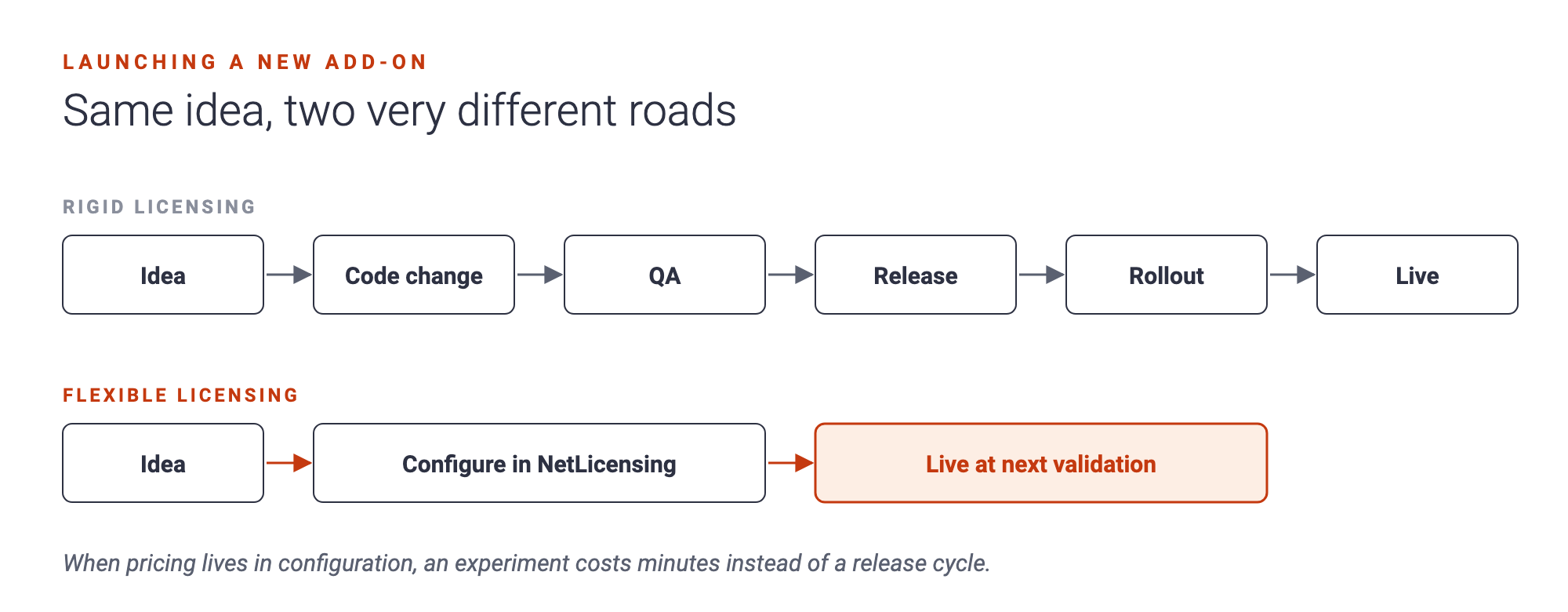
Flexible licensing turns experiments into configuration:
| Experiment | With rigid licensing | With flexible licensing |
|---|---|---|
| New add-on | New build or new key format | New feature license template |
| Longer trial | Code change, release | Change the trial period |
| Seasonal discount | Manual refunds or coupons in a separate tool | A promo code with start and end dates |
| Usage tier for API customers | New metering code | A credit-based module next to the subscription |
| Enterprise device cap | Custom build for one customer | A device quota on that customer’s license |
Symptom 5: new business models mean a rewrite
The software market keeps moving: from perpetual to subscription, from seats to usage, and now toward AI features billed by consumption. We looked at that shift in One Revenue Stream Is No Longer Enough.
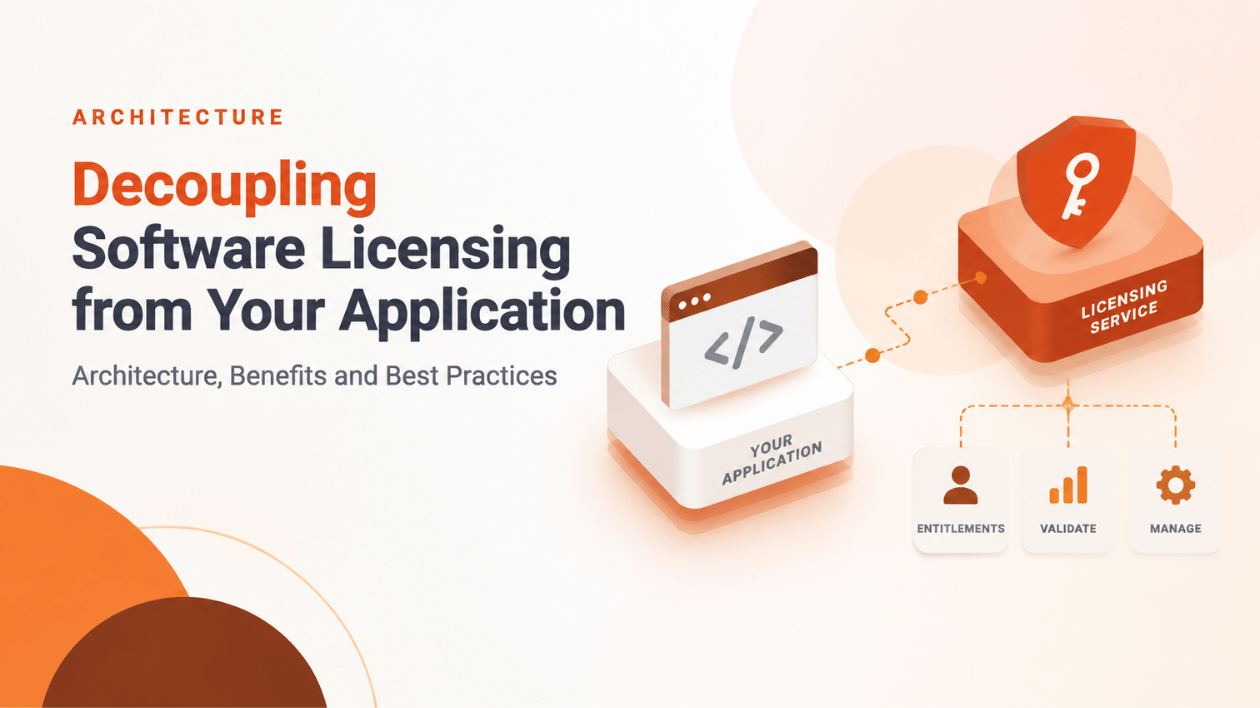
If licensing logic is spread across your codebase, every new model touches dozens of places. If it sits in one service that your application asks “what may this customer use?”, a new model is added beside the old ones. Existing customers keep their licenses. New customers get the new offer.
What flexible licensing looks like
Flexibility isn’t about having every option switched on. It’s about being able to say yes when the business needs something new. In practice that means:
- Entitlements, not editions. The code checks capabilities; licensing decides who has them.
- Several models side by side. Trial, subscription, features, devices, seats and usage, combinable per product.
- Changes without releases. Prices, periods, limits and promotions live in configuration.
- Per-customer exceptions. A special quota or a custom term for one enterprise customer, without forking anything.
- Self-service. Customers buy, renew and see their licenses without emailing support.
This is the idea behind NetLicensing. Each product can combine as many licensing models as it needs, one per product module. Prices, periods and limits are set in the Management Console or through the API. Customers buy and renew through the shop or your own billing system, and see their licenses in the Customer Portal. Your application keeps making the same validation call, whatever you change behind it.
A quick self-check
If you answer “yes” to two or more of these, your licensing is probably costing you money:
- Changing a price or plan needs a developer.
- You’ve turned down a deal because you couldn’t license it the way the customer wanted.
- Features have shipped to all plans because gating them was too much work.
- You maintain different builds for different editions.
- Your enterprise customers have “special” license keys nobody fully understands.
- You haven’t changed your pricing in two years, even though you wanted to.
Questions people ask
What is flexible software licensing? Licensing where products, prices, features, limits and models can change through configuration, without changing or redeploying the application.
Why do customers outgrow fixed licensing models? Their size, usage patterns and buying processes change over time. A model that fit a five-person startup rarely fits the same company at fifty people.
How can I upsell features without releasing new software? Ship all features in the code and gate them with entitlements checked at runtime. Selling a feature then only changes the customer’s license.
Is flexible licensing more complex to run? It’s simpler. Logic in one place is easier to change than logic spread across builds, keys and custom code.
Stop paying the hidden tax
The cheapest time to make licensing flexible is before the next pricing change, not during it. See how NetLicensing’s plans compare on the pricing page, or start for free and set up your product with more than one model from day one.
Happy Licensing!
Image Credits: NetLicensing
Related Posts